What Is the Difference Between Lithium Batteries and Gel Batteries?
Energy Storage Systems in Everyday Life
In our daily lives, we encounter energy storage units everywhere —
in our mobile phones, vehicle starter batteries, drones, and electric bicycles, among many others.
Each battery type has its own lifetime and price range.
While everyone demands uninterrupted energy, the cost of batteries used to be significantly high — but now, things are changing.
Due to common misconceptions, millions of lead-acid batteries are imported into our country every year, turning it into a lead waste field.
Many of these batteries fail within six months, leaving consumers and suppliers frustrated.
Most battery resellers do not understand the technical features or lifespan of the batteries they sell.
Likewise, buyers often choose the cheapest option without proper research — which usually results in higher long-term costs.
The purpose of this article is to show that the time has come for lithium batteries.
Below are the key reasons and technical comparisons.
Question: What Does a “Quality Battery” Mean?
Answer:
A quality battery is one whose technical specifications match real-world performance.
For example, if a battery is labeled 12V 100Ah, it should be able to discharge 100A at 12V for about one hour (Energy = Voltage × Current × Time).
If it does so, the capacity value is correct.
Another indicator of quality is the number of charge-discharge cycles (cycle life).
A higher cycle life means a higher-quality battery.
Question: How Should Battery Costs Be Calculated?
Answer:
Battery cost should be evaluated per charge-discharge cycle.
Example:
-
A battery costs 150 USD and lasts 300 cycles → 0.50 USD per cycle.
-
Another battery costs 450 USD but lasts 8,000 cycles → 0.056 USD per cycle.
Even though the second battery looks more expensive, it is 10 times more cost-effective.
As of 2023:
-
Lithium batteries cost around 300 USD/kWh,
-
Gel batteries cost around 150 USD/kWh.
However, lithium batteries last 6,000+ cycles, while gel batteries last only around 300 cycles.
Question: What Are the Differences Between Cheap and Expensive Lithium Batteries?
Answer:
Price differences can arise even between batteries claiming similar specifications because of:
-
Different cell capacities inside the battery
-
Different manufacturing dates
-
Varying BMS (Battery Management System) quality
-
Different warranty and support policies
-
Brand value and reputation
Uninformed use of lithium batteries can cause serious problems.
You must consider factors like:
-
Total connected load,
-
Peak current demands,
-
Continuous charge/discharge current,
-
Compatibility between the charger and the BMS.
Even among BMS units, prices can differ by up to 1000% due to quality variations.
DoD and Cycle Life
One of the most important indicators of battery quality is Depth of Discharge (DoD).
-
DoD means how much of the battery’s capacity is discharged during each cycle.
-
Technical datasheets often specify cycle life based on DoD.
Examples:
-
Cycle Life: 5,000 @ 100% DoD → can be fully discharged 5,000 times.
-
Cycle Life: 4,000 @ 80% DoD → can be discharged to 80% of its capacity 4,000 times.
Lower DoD increases lifespan, but requires higher initial capacity.
Cycle Life Comparison
When you ask, “How many years will this battery last?”,
if the seller says “5 years” or “10 years” without data, do not believe it.
-
Gel and sealed lead-acid batteries: 200–400 cycles
-
Lithium batteries: 1,000–12,000 cycles
A cycle means one full charge and discharge.
In off-grid solar systems and solar street lights, gel batteries are often used — but they are the most expensive solution over time.
Why So Expensive?
-
Gel battery: ~150–200 USD/kWh
→ lasts about 300–350 cycles → ≈ 0.50 USD/day -
Lithium battery: ~300–500 USD/kWh
→ lasts at least 8,000 cycles
→ even if you assume only 4,000 cycles, that’s ≈ 11 years of daily use
→ 0.10 USD per cycle, or 0.05 USD per cycle at 8,000 cycles
Hence, lithium batteries are roughly 10× more economical than gel batteries.
Unless you like replacing batteries every year, this calculation is essential for financial sustainability.
BMS – Battery Management System
Lithium batteries require precise charge and discharge control because short circuits can be dangerous.
The BMS monitors all cells, keeps voltage and current within safe limits, and ensures balanced performance across the pack.
This extends battery life and ensures safe operation.
Summary
Compared to gel batteries, lithium batteries are superior in every way:
-
Longer lifespan
-
Lighter weight
-
Faster charging and discharging
-
More environmentally friendly
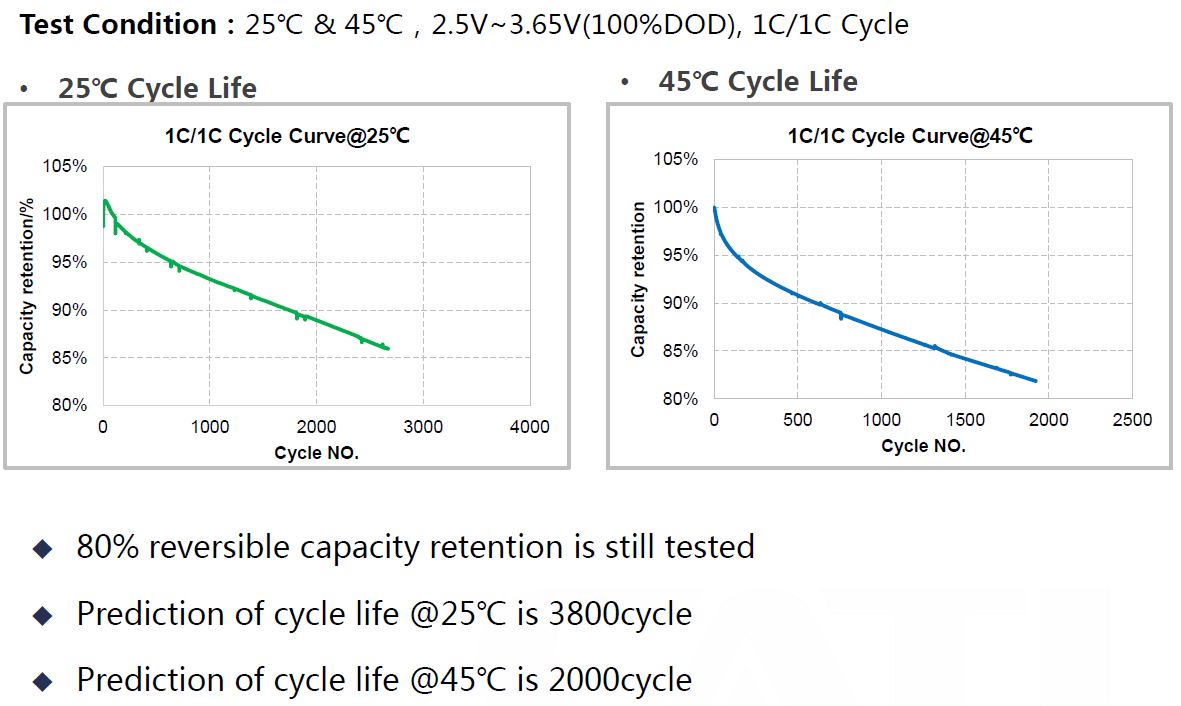
In the graph below (not shown here), you can see that a lithium battery operating at 25°C still maintains 85% capacity after 3,800 cycles, proving its long-term durability and reliability.
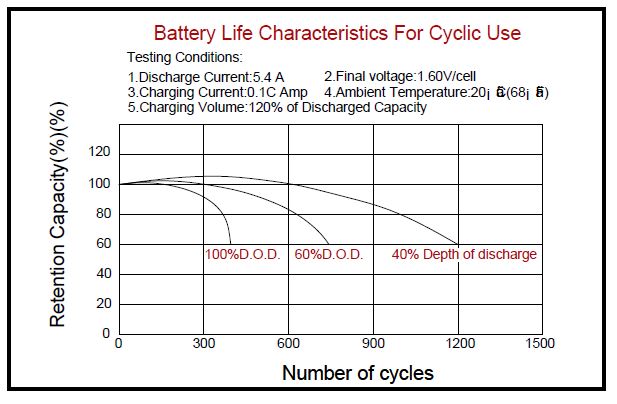
The following graph shows the cycle life and lifespan of Gel Batteries.
According to the graph, the lifespan of a Gel battery is approximately 350 cycles at 100% Depth of Discharge (DoD).
If the battery is discharged less deeply — for example, using only 40% of its capacity before recharging — the lifespan can reach up to 1,200 cycles.
The lesson to be learned is:
If one battery lasts 1 year under full discharge, using three batteries and discharging them less deeply can extend the overall lifespan to about 4 years.
Therefore, it is important to design the system so that batteries are not fully discharged.
Although we mainly focus on these two common battery types,
OPZ and OPZs (also lead-acid–based batteries) can reach 1,000 to even 2,000 cycles of lifetime.
However, when considering their weight, cost, and performance ratio, they are not economical unless absolutely necessary.
When choosing a battery, it is essential to read and understand the performance graphs.
There is no such thing as a “bad battery” — only poor project design or wrong selection.
